
How Durham Records Reach the Public
Durham has no single records warehouse. The legal keeper, or custodian, depends on who made or received the file. The Durham County Register of Deeds holds land instruments and local certificates. Durham Tax Administration keeps the owner roll. The elected Durham Clerk of Superior Court maintains court files, estates, and special proceedings. Durham City departments control municipal material. This division matters because a request sent to the wrong Durham portal may be delayed or redirected.
| Durham record set | Official custodian | Online route | Access path |
|---|---|---|---|
| Deeds, liens, and plats | Durham County Register of Deeds | Self-Service Web | Public index and images where available; historical and certified material at the office |
| Property and tax | Durham County Tax Administration | Real Property Records Search | Free current roll, tax bill, sales, and GIS links |
| Court cases and estates | Durham Clerk of Superior Court | Statewide eCourts Portal | Public case data online; kiosk, file, and copy access at the courthouse |
| Birth, death, and marriage | Durham Register of Deeds and NC Vital Records | ROD account search and certificate forms | Certified copies limited by statute and identification rules |
| Jail and correction records | Durham Sheriff and NC Department of Adult Correction | Detention route and Offender Public Information | Public status fields; protected medical and investigative facts withheld |
| City and county agency files | Durham department that holds the file | Separate Durham City and County portals | Inspection or copy, subject to exemptions and actual-cost rules |
An online Durham result is often only an index. It can point to a deed image, court file, or certificate request without making the full source available. Sealed cases, adoption and juvenile files, protected addresses, personal identifiers, and confidential investigative material remain outside ordinary open-record access. A missing Durham web result also does not prove that no file exists. Older Durham books, archived paper files, and office-only indexes require a counter or records request.
Durham Records Under Chapter 132
North Carolina Chapter 132 defines a record by its content and link to public business, not by whether it sits on paper, in email, or in a database. Section 132-6 allows any person to inspect and obtain copies as promptly as possible. State law sets no fixed number of days for production. The City of Durham’s response target is a local service goal, not a statewide deadline.
Inspection in Durham is normally free. Section 132-6.2 permits actual-cost copy charges and a reasonable special service charge when a Durham request needs extensive technology work or staff help. Ask for an estimate before that work begins. A clear written request is useful, but an agency generally cannot force use of its preferred form when the law does not require one.
When one Durham file mixes open and confidential facts, the custodian should separate the protected portion and release the rest. A denial should identify the legal basis. Section 132-9 provides a civil enforcement route, while mediation and attorney-fee rules depend on the dispute. Narrowing a broad Durham request by date, office, subject, case number, or parcel ID often resolves access faster than a legal challenge.
Durham Public Records Custodians
The Durham records system mixes county, city, and state offices. Durham deeds and local certificates go to the Register of Deeds. Judicial material belongs with the Durham Clerk of Superior Court, not the Clerk to the Board. General Durham County departments use the county request portal, while the Durham Sheriff, elections office, courts, and deed records follow their own routes.
Durham County Register of Deeds
201 E. Main Street, Administration Building II
Durham, NC 27701
919-560-0480
Weekdays, 8:30 a.m. to 5:00 p.m.
Deed, plat, assumed-name, and local certificate services
Durham Clerk of Superior Court
510 S. Dillard Street
Durham, NC 27701
District and Superior Court files, estates, guardianships, foreclosures, and special proceedings
Durham County courthouse records access
Durham County Public Information
Routes requests for general Durham County departments and maintains the Durham County request portal
919-560-0008
publicinformationoffice@dconc.gov
Durham County department request routing
Counter cutoffs at the Durham Register of Deeds come before closing time for some services. Durham real-estate recording ends at 4:45 p.m. The Durham office stops vital amendments after 4:00 p.m., marriage licenses after 3:30 p.m., and certified birth, death, or marriage copies after 4:45 p.m. Check the Durham office page before a time-sensitive visit.
Search Durham Deed Records
The Durham Register of Deeds Self-Service Web searches real-estate instruments and, after profile creation, birth, death, and marriage indexes with printable uncertified copies. Its disclaimer draws a key line: certified and historical indexes remain at the Durham office. Historical Record, Condo Books, Corporate Books, Mortgage Books, and Plat Books are exceptions to ordinary online document access.
The Durham search screen supports several paths. A broad surname helps when spelling varies. A date span or document type can then reduce a long result set. Grantor means the party transferring an interest, while grantee means the party receiving it.
| Self-Service field | Input | Best use |
|---|---|---|
| Party and role | Name plus grantor/grantee role | Trace a party through deeds, liens, easements, and other instruments |
| Document type | Category choice | Limit results to deeds, trusts, cancellations, plats, or assumed names |
| Recording dates | From and to dates | Separate common names or focus on a known transaction period |
| Book and page | Book/page pair | Retrieve a known citation, subject to historical-book rules |
| Instrument number | Identifier | Open a known indexed filing directly |
Historic Durham plat books 1 through 31 may have A and B splits. Add the letter where the book calls for it. If that still fails, ask Durham staff to check the historical index rather than treating the failed retrieval as proof of no filing.
See the Durham deed-search gateway as captured here.
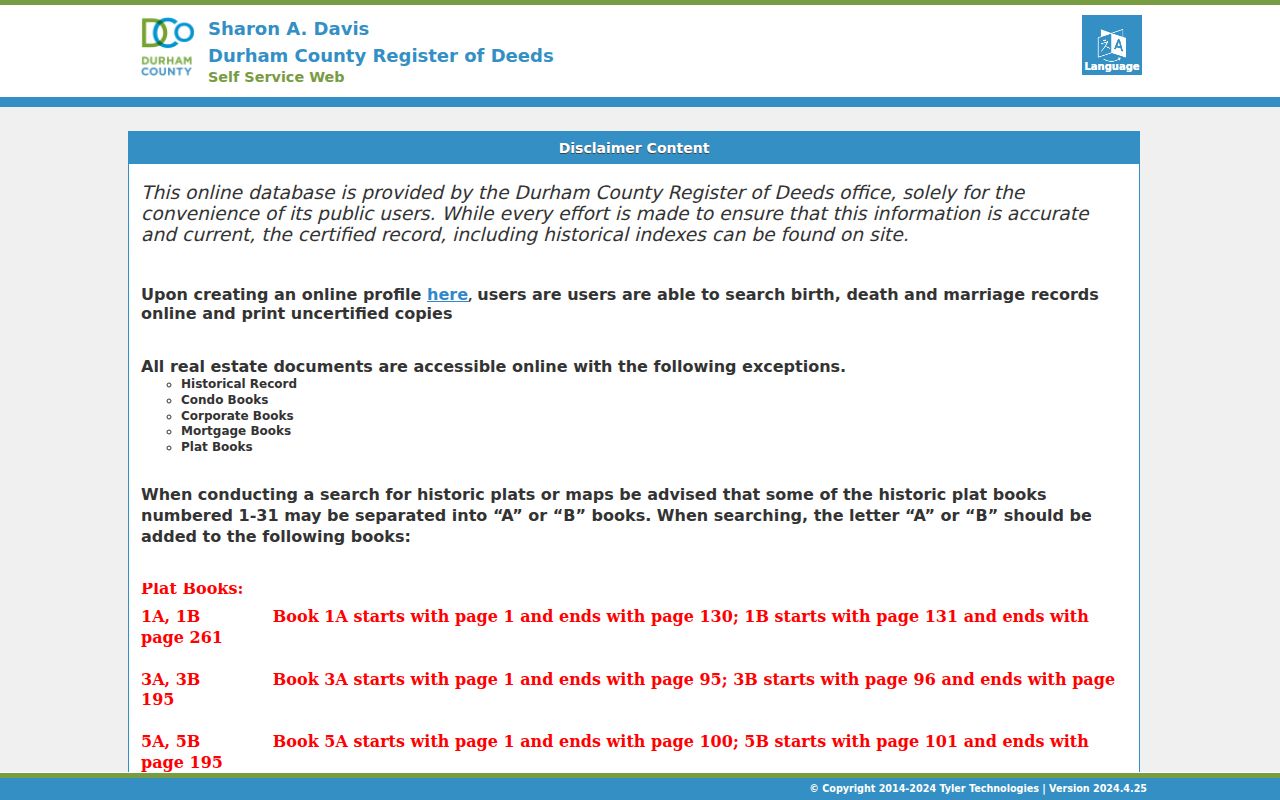
The Durham gateway’s warning explains why a complete deed check can require both the web index and the Durham Register’s on-site books.
Durham Property Records and GIS
Durham County Real Property Records Search accepts an owner name, property address, parcel ID or REID, and other map or account criteria. Results can show the January 1 owner, co-owner or vesting, tax mailing address, physical situs address, deed citation, values, an improvement photo, three years of sales, the tax bill, and a GIS link. REID is Durham County’s real-estate record identifier. Situs means the parcel’s physical address.
Those Durham fields answer different questions. A taxpayer mailing address is where the bill goes, not proof that the owner lives there. A recent Durham deed may also appear at the Register before the annual Durham tax roll reflects the new owner. For mapped boundaries, acreage, and jurisdiction, continue through the county’s Land Records and GIS route. Deeded acreage can differ from the GIS calculation, so a recorded survey or plat remains the stronger boundary source.
Durham’s January 1, 2025 reappraisal changed values, not ownership. Date the valuation and compare the deed date before drawing a conclusion from a parcel card.
Note: A Durham mailing label does not establish Durham City or County jurisdiction; the parcel record and GIS map control the route.
Durham Court Records Since 2024
Durham joined Odyssey and statewide North Carolina eCourts on April 29, 2024. All North Carolina counties finished conversion on October 13, 2025. This Durham shift is a useful records-era marker, not the first date of every case online. Older Durham data migrated, document depth varies, and a midnight time on a pre-launch event may be conversion metadata.
Portal Smart Search accepts a party name, business name, or case number. Other Durham routes include party, citation, and case-number searches, with Durham County, case type, and date filters. A Durham result may show the case number, style, county, type, filing date, status, parties, lawyers, public charges, events, and disposition. It does not make every filed document remotely viewable.
Use the Durham courthouse kiosk or Clerk counter for a known case file, a paper archive, or a certified copy. Federal matters involving Durham instead use the Middle District of North Carolina and its PACER docket service. Durham researchers should give Durham name variants, a rough year, record type, and case number when known. Durham court files for estates and special proceedings stay with the Durham Clerk. General County NextRequest cannot produce them.
Note: A party-name match is an index lead, not proof that the named person is the individual being researched.
Durham Vital Records Access
North Carolina vital certificates do not operate as a free statewide name search. The Durham Register of Deeds issues certified Durham County birth, death, and marriage copies for $10 and supports online and mail channels. NC Vital Records supplies statewide birth, death, marriage, and divorce certificates through its applications. Its official fee schedule sets the standard $24 fee for a three-year search and one copy if found. The search fee is not refundable.
Under N.C.G.S. §130A-93, certified copies are limited to the person named, a spouse, sibling, direct ancestor or descendant, stepparent or stepchild, or an authorized agent, lawyer, or legal representative. Death certificates also have a route for someone seeking a legal determination of personal or property rights. Identification, a signed application, and payment are required.
Certificate access. A Durham index entry or uncertified print does not grant eligibility for a certified copy. Use the event or license county, not a current address.
There is no verified North Carolina rule that simply opens births after 100 years and deaths after 50. For Durham family history before state registration, use Durham County registers, State Archives holdings, newspaper indexes, church records, and library collections. State birth registration generally starts in October 1913, while death holdings generally begin in 1930.
Durham Custody and Incident Records
The Durham Sheriff’s detention route covers current Durham County custody. Durham booking data may include a name, custody status, charge, bond, court date, and release status where published. A booking shows temporary custody, not a conviction. Confirm the related Durham case in eCourts.
For state prison or community-supervision information, the NC Offender Public Information search accepts an offender number, name, and filters such as status or location. The North Carolina offender registry offers name and geographic searches for statutory registrants. Registry information is for public protection and must not be used to threaten or intimidate anyone.
Durham Police may release the public incident-information core and reports subject to N.C.G.S. §132-1.4. Investigative details, victim information, juvenile facts, and other protected content may be withheld or redacted. A Durham request works best with the report number, date, location, and involved name.
Route Durham Records Requests Correctly
Durham City and Durham County use separate request systems. City records include council actions, permits, cemetery deeds, and police administrative material held by the responsible department. The City records request page asks users to search available material first, submit online rather than by phone, and gives a 14-day staff-response target. The target does not promise production within 14 days.
The county portal covers general Durham County departments but excludes several major custodians. Register of Deeds material stays with that office. Sheriff records go to the Sheriff. Elections requests follow Board of Elections channels. Judicial files go to the Clerk and Judicial Branch. Sending one broad request to County NextRequest will not override those custody lines.
Open the Durham County request route shown in this approved capture.
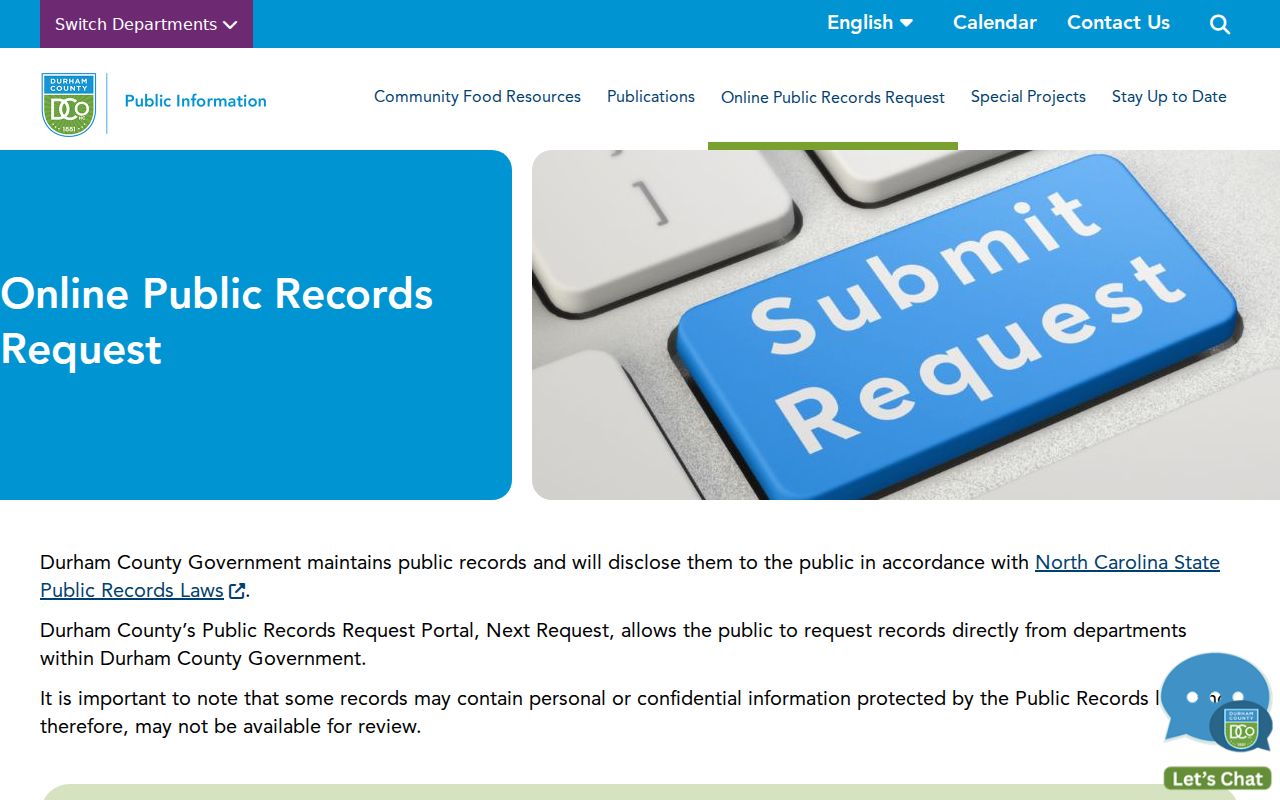
The county page’s routing notes help keep deed, Sheriff, court, and department requests with the office that can answer them.
Durham Records Copy Fees
Fees depend on the product. Chapter 132 inspection is generally free, while copies may be charged at actual cost. Extensive technology or clerical work can support a reasonable special service charge. The city says most requests are free and gives advance notice when media or copying costs apply.
Durham Register of Deeds charges 10 cents per computer page or 25 cents per copier page for uncertified copies. A certified copy costs $5 for the first page and $2 for each added page. An 18-by-24-inch map costs $2. These are copy prices, not universal search fees. Recording a new instrument uses a different schedule.
State Vital Records charges $24 for a three-year search with one copy if found and $15 for another copy of the same record. County vital certificates cost $10. Ask the exact office for an estimate when a court file, archive reproduction, or large electronic request may carry a separate charge.
Protected Records and Identifiers
Open access in Durham does not erase privacy rules. Personal identifiers protected by §132-1.10 should be redacted while the separable public part is released. Juvenile and adoption files, sealed or expunged cases, confidential vital material, protected voter addresses, and sensitive security or personnel facts remain restricted. The federal Driver’s Privacy Protection Act also blocks a general motor-vehicle people lookup.
North Carolina’s Address Confidentiality Program gives qualifying survivors a substitute address and mail forwarding. Public sources should never be combined to expose an actual protected location. A recorded image likewise does not give permission to republish any personal identifier that escaped redaction.
- Custodian
- The agency or official that holds and controls a record.
- Index
- A searchable finding aid that may identify a filing without showing the full document.
- Certified copy
- An official copy authenticated by the issuing office, usually for a set fee.
- Exemption
- A law that permits or requires an agency to withhold specific content.
North Carolina’s narrow 2025 law on nonprofit supporter, member, and donor compilations is not a broad consumer privacy act. Its scope should not be used to claim a general deletion right for government filings.
Request Durham Public Records
A focused Durham request gives the custodian enough detail to locate the file without guessing. State the record, date range, department, subject, and known identifiers. Say whether inspection, an electronic copy, a plain paper copy, or certification is needed. Keep the acknowledgment and any fee estimate.
- Identify the custodian. Separate city, county, Sheriff, Register of Deeds, elections, and court material before choosing a channel.
- Search the published source. Check the office portal, prior releases, index, or catalog so the request can cite a case, parcel, instrument, or report number.
- Describe one record set. Provide names with variants, a useful date span, record type, and delivery preference. Avoid asking the office to answer a broad question or create a new analysis.
- Confirm cost and timing. Ask for an estimate before extensive service and pay the stated copy or certification charge through the official channel.
- Address a denial precisely. Request the statutory basis and any separable open portion. Narrow the scope when that can resolve the cited issue.
Lawful personal use. Records can support genealogy, estate work, property verification, and civic review. North Carolina law prohibits stalking, identity theft, threats, and other harmful misuse of personal facts.
If no web result appears, ask about the index range, paper series, archive transfer, or office-only book. Durham County began in 1881 from Orange and Wake Counties. Earlier deeds, marriages, estates, and court matters may therefore sit under a parent county even when the historic place name says Durham.